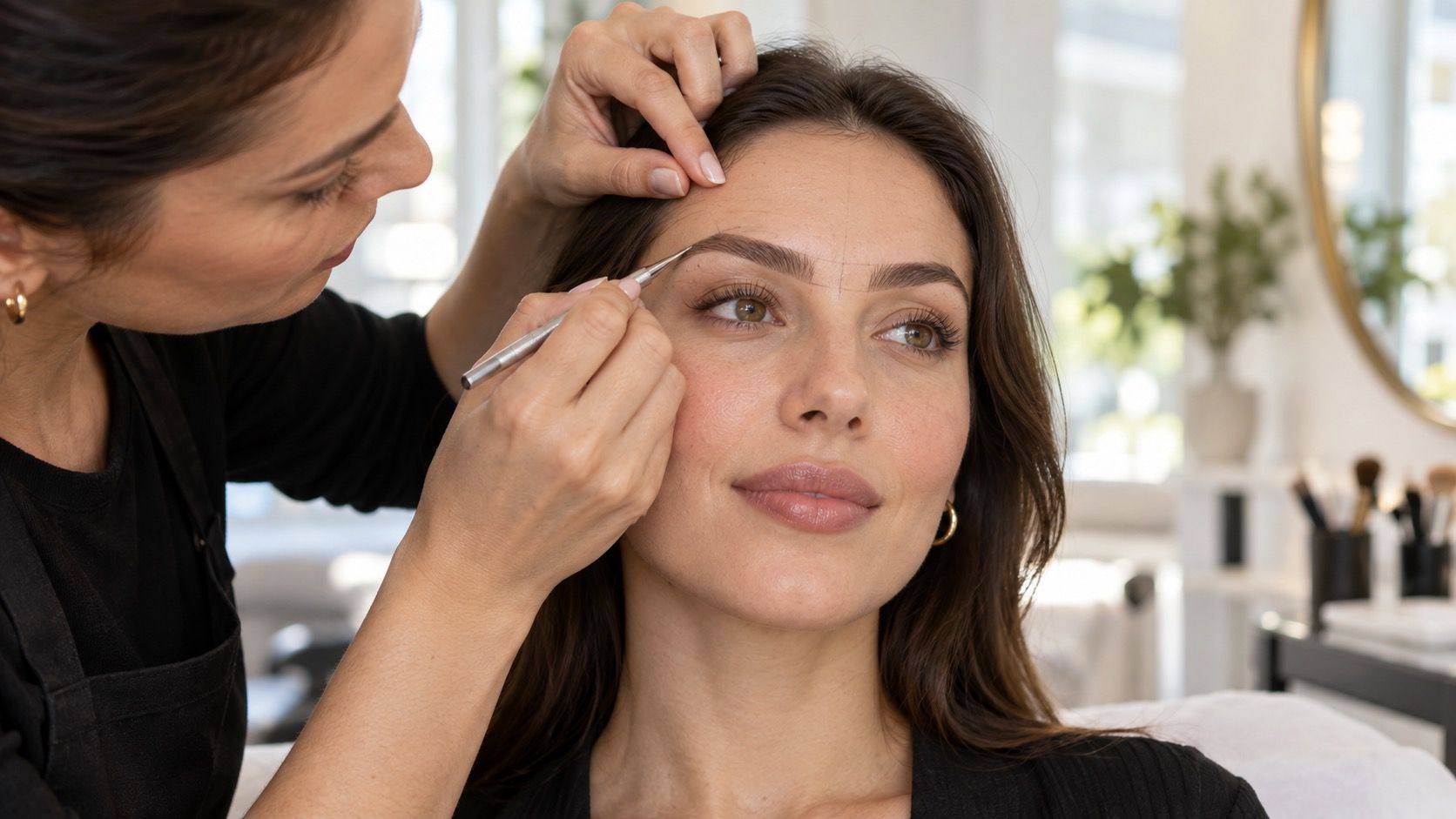
A diamond face shape is often noticed first through its cheekbones. They sit as the widest, most prominent part of the outline, while the forehead and chin taper inward. That creates a refined, sculpted effect, but it also explains why a hairstyle that looks merely neat on someone else can feel too narrow at the temples or too wide through the cheeks. Styling works best when it gives the upper and lower face a little companionship rather than trying to disguise the cheekbones.
Recognise a diamond face by its widest point
Put hair away from the temples and compare four areas: forehead, cheekbones, jaw, and chin. A diamond face usually has a narrower forehead, a cheekbone line that is clearly widest, and a chin that narrows to a soft or more defined point. The jaw is often shorter and less broad than on a square face. From straight on, the contour can look like it expands around the middle before tapering at both ends.
Haircuts that frame cheekbones without crowding them
High cheekbones alone do not determine face shape. An oval face can have high cheekbones but usually has a more even, elongated outline. A heart face has a wider forehead that then narrows to the chin; a diamond face typically narrows at the temples as well. Take a photo from several steps back at eye height, because a close phone camera can make the central face look wider than it is.
Use measurements as a check. If cheekbone width is the largest number and both forehead width and jaw width are noticeably smaller, diamond is a useful description. There is no meaningful boundary where one millimetre changes the label. The purpose is simply to understand where visual width naturally sits before choosing hair, frames, or accessories.
The best haircut for a diamond face usually places softness near the temples, the chin, or both. A shoulder-length cut with face-framing layers can do this well when the first layers begin around the cheekbones and continue downward. The layers should move rather than stop in a shelf exactly at the widest point. Loose bends and soft texture keep the sides from looking pinched while leaving the cheekbones visible.
A chin-length bob or a bob that falls just below the jaw can add welcome width to the lower face. Choose a slightly rounded perimeter, especially if your hair is fine or naturally straight. A severe, narrow bob tucked tightly behind both ears may emphasize cheekbone prominence, whereas a small bend at the ends makes the outline more balanced without becoming fussy.
Short cuts work beautifully too. A pixie with soft temple pieces, a side fringe, and moderate crown volume prevents the forehead from reading too narrow. Avoid piling all lift at the crown while keeping the sides flat; that can make the middle of the face appear even wider by comparison. On curly hair, a rounded shape with controlled volume at the temples is often easier than trying to force a long, narrow silhouette.
| Styling aim | Helpful detail | Potential problem |
|---|---|---|
| Balance narrow temples | Side fringe, soft volume near the upper sides | Hair pulled completely flat behind the ears |
| Give the chin more presence | Bob at or below the jaw, fuller ends | Very thin lengths ending above the chin |
| Keep cheekbones as the feature | Clean face-framing with flexible texture | Heavy horizontal layers across the cheeks |
Use bangs and partings to widen the upper face gently
A side fringe is one of the simplest ways to introduce temple width. It creates a diagonal over the forehead and blends into the cheek area, which is more forgiving than a hard horizontal line. The fringe can be long enough to tuck behind one ear; that gives you two looks from the same cut and is useful if you wear glasses most days.
Soft curtain bangs also suit diamond face features when they are not cut too narrowly. Let the outer pieces travel toward the temples, then merge into the rest of the haircut. A tiny center-parted curtain bang can make the forehead appear even narrower, so ask for enough width and softness around the outer brow area. A lightly broken edge is usually more wearable than a dense, perfectly straight one.
Center parts are possible with long hair, particularly when there is wave or volume beside the temples. If your hair lies flat, move the part a little to one side or create a gentle root lift before judging it. The difference is small but the face can look less diamond-shaped when the upper outline is not framed by two tight vertical lines.
Eyewear should support, not compete with, the cheekbones
Oval glasses, rounded rectangles, and lightly upswept frames often complement a diamond face because they bring visual width to the forehead without creating another sharp central point. Frames with a softened brow line tend to sit comfortably with prominent cheeks. Try lens depth as well as width: a very shallow rectangle can make the middle face look broad, while a slightly deeper lens gives the eye area more room.
Cat-eye frames can be especially effective when the outer corners lift toward the temples rather than extending far beyond them. They echo the upward direction of the cheekbones and add width where the face narrows. Very narrow rimless glasses may disappear against a strong cheekbone structure; that can be ideal for a minimal look, but a more substantial frame often gives better balance in photographs.
With sunglasses, check where the lower rim lands. If it cuts across the fullest part of the cheek, the frame can feel crowded. A medium-size rounded pair that sits just above the cheekbones or follows their curve usually looks more settled. Fit matters as much as shape: slipping glasses move the visual center downward and become distracting.
Makeup and jewellery can change emphasis in small ways
Place blush slightly above the cheekbone and blend outward toward the temple rather than concentrating a bright spot directly on the widest point. This keeps the natural structure visible but avoids creating a stripe of extra width. Soft highlight at the high point of the cheekbone can look fresh; a strong metallic band can look theatrical in daylight, so build it gradually.
A brow with a soft arch or a straight, full shape can make the forehead area feel wider. Overly thin brows leave the temple area exposed, while a squared-off brow may compete with an already angular outline. For earrings, small hoops, rounded studs, and drops that gain width near the jaw bring attention to the lower face. Extremely wide ear cuffs at cheek level can amplify the middle width, which may be exactly the effect you want for an evening look.
For facial hair, a little fullness through the chin can counter a tapered lower face. A rounded beard or short stubble left slightly fuller at the chin tends to look more balanced than a beard shaped into a narrow point. The most flattering line is one that follows natural growth and can be maintained without daily over-sculpting.
Choose the version that works in everyday light
Ask a stylist where your haircut will hold its volume after a normal wash and whether the face-framing pieces will still sit well with your usual part. Bring images of people with comparable hair density, not just a similar face outline. A style that relies on polished waves can be disappointing if your hair is very fine and you prefer to air-dry.
A diamond face shape guide is useful when it explains why more temple softness, a lower-weighted bob, or oval glasses feel easy to wear. It should not make high cheekbones into a problem to solve. Keep the features you like visible, and use proportion only to make the whole look feel intentional.