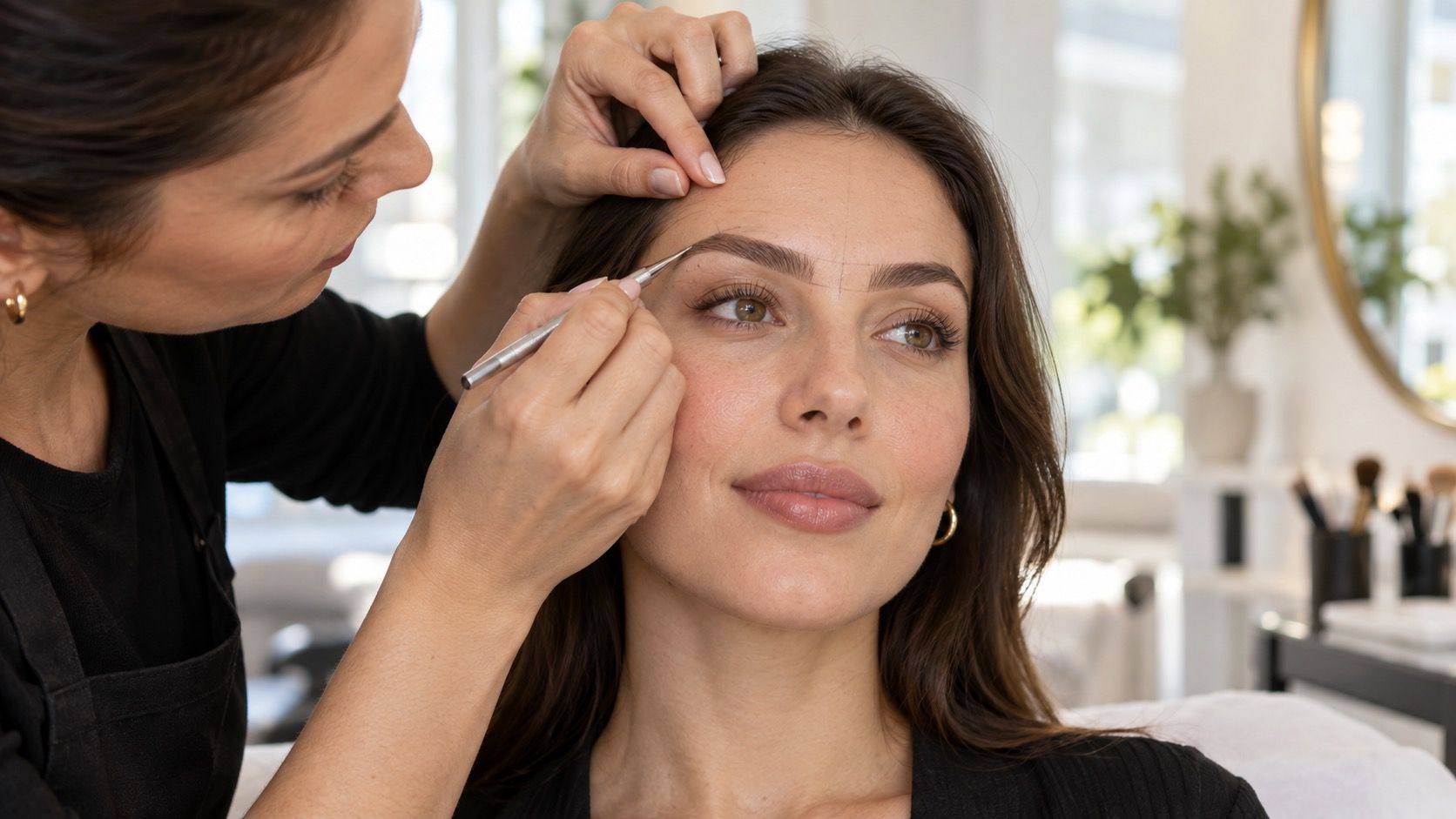
A face shape analyzer is most useful when it turns a vague impression into a few repeatable checks. Rather than searching for a perfect label, look at where your face is widest, how much longer it is than it is wide, and whether the jawline tapers, curves, or stays fairly straight.
What a face shape can and cannot tell you
Face-shape names are shorthand for proportions, not a verdict about how you should look. An oval face is usually longer than it is wide with a softly narrowed jaw; a round face has similar width and length with curved edges; a square face has a stronger, more even jaw and forehead. Heart, diamond, oblong, rectangle, and triangle shapes describe other combinations of width and contour. Most faces sit between two descriptions, especially when the hairline or jaw is softly defined.
Set up before you measure
The useful part of a face shape test is comparison. A haircut, a pair of frames, or a brow shape changes the visual balance around the forehead, cheekbones, and chin. That does not mean one shape has forbidden choices. It means you can predict whether a style adds width at the temples, height at the crown, or emphasis at the jaw before committing to it.
Pull hair fully away from the face, including short pieces around the temples. Stand in even daylight or near a plain wall with a lamp facing you; light from one side can make one cheekbone seem higher and a shadow can make a soft jaw look sharper. Remove glasses and keep your expression neutral. A relaxed mouth matters because clenching the jaw changes the outline you are trying to read.
Use a flexible measuring tape if you have one, but do not wrap it around curves. You want straight, point-to-point distances, so a ruler held gently in front of the face works too. Record the numbers once, then repeat them after a short pause. If a second attempt differs by more than a centimeter, the setup needs adjusting rather than a more complicated formula.
Take the four measurements that matter
First measure face length from the center of the natural hairline to the lowest point of the chin. Then measure forehead width from one temple area to the other, at the broadest part rather than directly across the brows. For cheekbone width, find the high outer point under each eye and measure straight across. Finally, note jaw width from the chin to the angle below one ear, then double it. This last figure is approximate; the shape of the jaw is often more revealing than a tiny numerical difference.
| Check | What to notice | Why it helps |
|---|---|---|
| Face length | Hairline to chin | Separates longer outlines from compact ones |
| Forehead | Widest temple-to-temple point | Shows whether the upper face leads the outline |
| Cheekbones | High point below each outer eye | Often identifies the broadest area |
| Jawline | Width plus angle or curve | Distinguishes soft taper from a broad base |
Do not chase millimeter precision. A face that measures 18 centimeters long and 17 centimeters across is not automatically round, just as a jaw that is slightly narrower than the forehead is not automatically heart-shaped. Read the relationship among all four measurements and then check that relationship against the visible outline.
Use the mirror test to read the outline
Step back far enough that you are not studying pores or asymmetry. Look for the widest horizontal area first. If forehead and jaw are close in width and the sides run fairly straight, square or rectangle may be a better starting point than oval. If cheekbones are widest and both forehead and jaw narrow away from them, compare diamond and oval. If the upper face is noticeably widest and the chin comes to a gentle point, heart is a useful description.
The mirror test works best when you ignore hairstyles. A side part, bangs, beard, contour, or even a heavy brow can suggest a different outline. Trace only the hairline, temples, cheek area, jaw angle, and chin in your mind. If one side differs from the other, use the general pattern; natural facial asymmetry is common and not evidence that the measurements failed.
Check with a front-facing photo
A front-facing photo is a valuable second opinion, but only if the camera is at eye level and far enough away to avoid wide-angle distortion. Use the rear camera when possible, set it on a shelf or tripod, and step back before cropping. A phone held close below the chin enlarges the lower face; a high selfie angle can make the forehead look broader and the chin smaller. Neither image is a reliable face shape analyzer.
Take two photos in the same light: one with hair pulled back and one in your usual styling. The first helps identify proportions; the second helps you see why a familiar haircut may have influenced your guess. Compare the photo with your written measurements rather than relying on a face shape filter, which may be reading shadows, makeup, or lens perspective as structure.
How to compare the most likely shapes
Start with the two closest candidates, not every label at once. Oval usually has length greater than width, gently rounded sides, and a jaw narrower than cheekbones. Round tends to have a similar length-to-width ratio and no prominent corners. Square has a similarly broad forehead, cheekbones, and jaw with a more defined lower edge. Rectangle is longer than square while keeping that straighter side line. Heart and diamond both taper toward the chin, but heart is broader at the forehead while diamond is broader at the cheekbones.
If your features fit two shapes, keep both in mind. Someone with a long oval face may borrow rectangle styling ideas; someone with a soft square jaw may prefer round-face hair advice. The label should describe the strongest pattern, while your individual features decide what feels balanced.
Common mistakes that make results less useful
The biggest mistake is measuring over hair, glasses, or a moving expression. Another is using a close selfie as the only evidence. Natural hairlines are irregular, so take the center rather than the highest or lowest stray section. Beards can hide the jawline, and weight changes or facial swelling can temporarily alter soft contours without changing the underlying bone structure.
Finally, avoid treating a single result as permanent. Repeat the check in neutral light when your hair is pinned back, then use the result as a practical reference for styling experiments. A good answer to what is my face shape is not the most dramatic category; it is the one that keeps matching your forehead, cheekbones, jawline, and overall length when you look again.