You do not need an app or a perfectly symmetrical face to find your face shape. A clear mirror, steady light, and a few rough measurements are enough to show the pattern formed by your forehead, cheekbones, jawline, and face length.
Prepare the face you are actually trying to assess
Begin with dry hair clipped away from the temples and forehead. That sounds minor, but a fringe can hide the width that separates a heart-shaped face from an oval one, while loose curls can add apparent width at the cheeks. Remove glasses, keep your shoulders level, and let your mouth rest. A smile is lovely, but it lifts the cheeks and changes the outline.
Measure face length from hairline to chin
Choose light that falls evenly from in front of you. Window light on a cloudy day is often easier to read than a ceiling light, which puts shadows below the cheekbones and jaw. Stand about an arm's length from the mirror. Being too close makes every small asymmetry look decisive; being farther back lets you see the outline as a whole.
Locate the middle of your natural hairline and measure straight down to the lowest point of the chin. Record the result in centimeters. Do not follow the curve of the nose or press a soft tape into the skin; a straight visual distance is what matters. If the hairline has a widow's peak or uneven growth, use the central average rather than one high or low point.
Face length gives context, not the answer alone. A long measurement can point toward oval, oblong, or rectangle, but the forehead and jaw decide which one fits. A compact measurement can occur on a round face, a soft square face, or a short oval face. Keep the number beside the other checks instead of treating it as a score.
Measure the forehead, cheekbones, and jawline
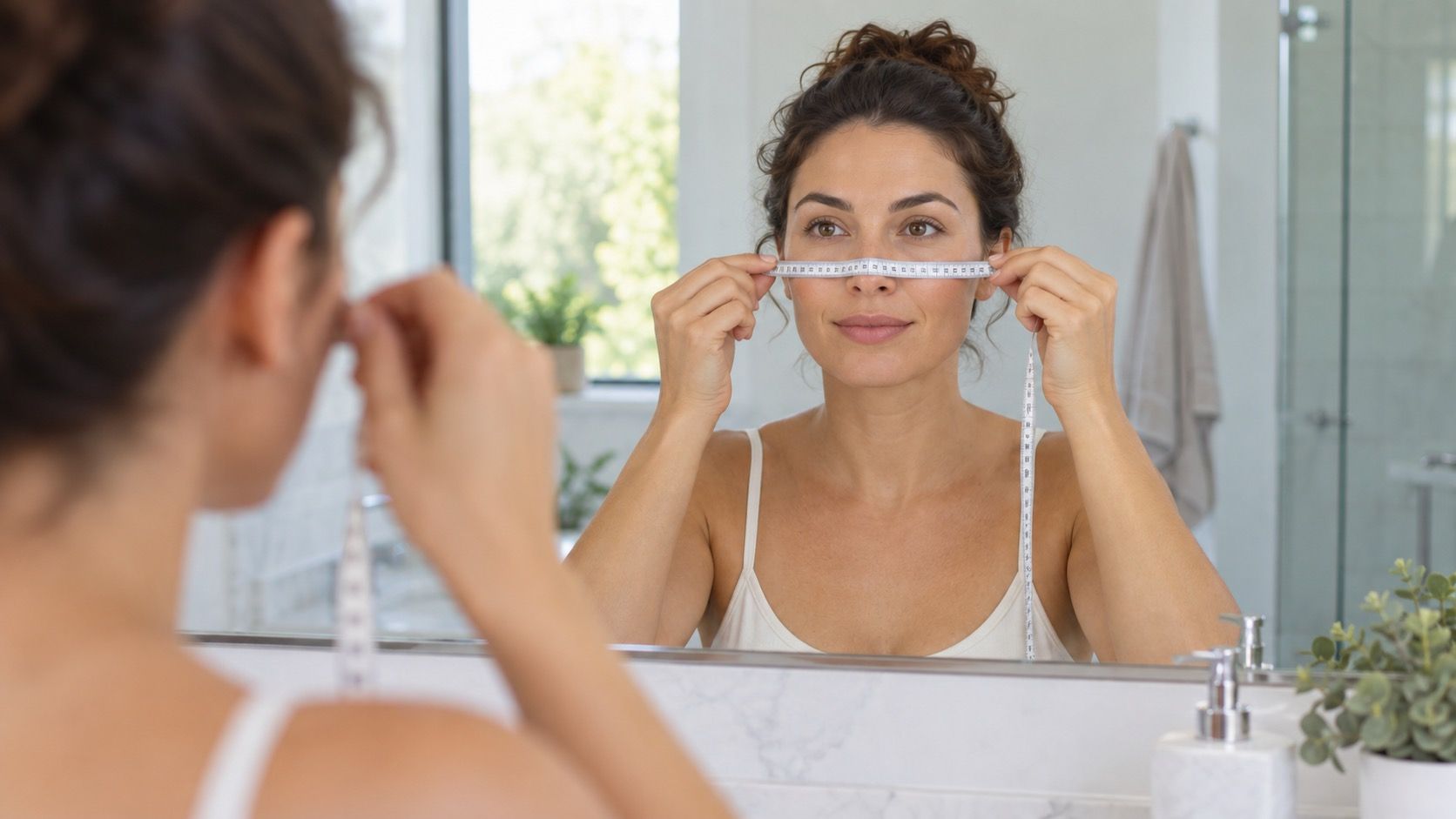
For forehead width, measure from the broadest point near one temple to the matching point on the other side. For cheekbones, use the high outer points below the eyes rather than the full fleshy cheek. The jawline is easiest to estimate by measuring chin to jaw angle on one side and doubling it. If the angle is hard to locate, look slightly to the side in the mirror first, then return to face forward.
| Area | Simple home check | Useful clue |
|---|---|---|
| Forehead | Temple to temple at the widest point | Can lead a heart or triangle outline |
| Cheekbones | High point under each outer eye | May be the dominant width in diamond or oval faces |
| Jawline | Chin to jaw angle, doubled | Shows a broad base, soft curve, or taper |
| Face length | Center hairline to chin | Sets the overall vertical proportion |
Repeat each check once. If the figures change a lot, the issue is usually tape position, not your face. Measurements within about a centimeter of one another should be read as similar. The visible outline and the placement of the widest point are more useful than claiming a false level of precision.
Read the outline before naming the shape
Look at the outer edge from forehead to chin. A face with gently curved sides, a slightly narrower jaw, and more length than width often reads oval. Similar width and length with full cheeks and a rounded jaw often reads round. A face with a broad, defined jaw and a forehead of similar width tends toward square; when it is clearly longer, rectangle is a more helpful label.
For tapering shapes, ask where the width sits. A forehead that is visibly broader than the jaw suggests heart, especially with a narrower chin. Cheekbones that are widest while both forehead and jaw recede suggest diamond. A jaw that is the strongest width can indicate triangle. These are working descriptions, not boxes, and a soft version of one shape can overlap with another.
Use a photo without letting the lens decide
To find your face shape from a photo, use a rear camera at eye level and place it several feet away. A close front-camera selfie enlarges the center of the face and can make the jaw or cheeks appear wider than they are. Keep the head upright, look at the lens, and use a neutral expression. Bright side light or a tilted head can produce a surprisingly convincing but misleading result.
Take at least two shots and compare them with the mirror. If the photo says round but the mirror and measurements show a longer outline and a soft narrowing jaw, trust the repeated evidence. Camera distortion is especially noticeable on phones with wide lenses, and it is one reason a face-shape filter should be treated as entertainment rather than a final assessment.
What to do when you fit two shapes
Many people do. A person can have oval face length with a heart-like hairline, or a square structure softened by rounded cheeks. Write down the two strongest candidates and notice which traits repeat: cheekbone width, the angle of the jaw, and the relationship between face length and width. This is more realistic than forcing your features into a diagram.
For styling, choose the detail you want to balance. If a side part and crown volume flatter you, it does not matter whether the label is oval or soft rectangle. If angular frames make the cheeks feel more defined, that is useful feedback whether the result is round or oval. The practical goal is to understand proportions well enough to make choices, not to pass a face shape test.
Keep the result useful rather than rigid
Check again when you are not wearing contour makeup, when hair is pinned back, and when your face is not puffy from a late night or seasonal allergies. These variables affect how the soft tissue reads in a mirror. The bone structure underneath remains, but the outline can look different from day to day.
Once you know how to tell your face shape, use it as one piece of styling information. Hair texture, density, personal taste, prescription lenses, and the way you like to wear makeup all deserve equal weight. The best result is a clear description you can revisit, not a rulebook that makes ordinary choices feel restricted.
Make your result repeatable
Write the four measurements down with the date and save one clean front-facing photo in a private folder. The point is not to monitor your appearance; it is to avoid starting from zero when comparing a new fringe, frame, or haircut. When a style feels different from what you expected, check whether it changes visible forehead width, adds volume at the cheeks, or exposes more of the jaw. That kind of observation turns a label into genuinely useful personal information.